End of Year Review: 2025
What A Year!
Introduction
2025 was a standout year for DexTrac, and a landmark one for the blockchain industry.
We saw meaningful growth across many of the services we support. Just as importantly, the industry itself matured: regulation got clearer, institutional adoption deepened, and momentum shifted decisively in the right direction.
It’s no exaggeration to say 2025 may go down as the most pivotal year for DexTrac — and for the industry — since the release of the Bitcoin white paper. Why? Let’s dive in.

TRUMP!
No single event had a greater impact on the global blockchain and digital asset landscape in 2025 than the inauguration of Donald Trump as President of the United States.
Whatever one’s personal politics or geographic vantage point, the return of Trump to the White House sent an unmistakable signal: his administration would take a markedly pro-crypto stance and unwind the restrictive regulatory approach that had defined the previous administration.
Trump even stated his ambition to make the United States the “crypto capital of the world,” framing digital assets as a driver of economic growth and technological leadership.
Upon taking office, the Trump effect was immediate: confidence rose, optimism returned to the sector, and, crucially, the path for blockchain innovation became far clearer. The impact rippled beyond the U.S., as governments worldwide began reevaluating their crypto policies, fueling renewed momentum throughout the space.
It was the reset the industry desperately needed.

What a GENIUS act!
On 18 July 2025, President Trump signed the GENIUS Act into law. In his remarks he said:
“The Genius Act creates a clear and simple regulatory framework to establish and unleash the immense promise of dollar-backed stablecoins. This could be perhaps the greatest revolution in financial technology since the birth of the internet itself.” Source
There’s been no shortage of coverage on the details of the GENIUS Act — but the TL;DR is simple: The U.S. gave stablecoins a green light and a big thumbs up. In practice, the impact of the GENIUS Act has been immediate and tangible. Stablecoins have moved into the institutional mainstream, with major banks, fintechs, and enterprises now actively integrating them into real-world operations.
What does this mean for DexTrac? A lot. We partner with the protocols powering this shift, supporting the data feeds, cross-chain infrastructure, and proof-of-reserve mechanisms that stablecoin issuers and users rely on. And, as stablecoins become ever more ubiquitous across international finance, the role of the infrastructure providers behind them will grow more critical.
But Wait, There’s More….
While the signing of the GENIUS Act was a hugely significant milestone, it may ultimately prove to be just the prelude to something even more consequential: the Digital Asset Market Clarity Act. Commonly referred to as the Clarity Act, this proposed legislation would, if passed, establish a comprehensive federal framework for digital assets in the United States.
In short, the Clarity Act has the potential to reshape how digital assets are defined and regulated, with ripple effects extending deep into the global financial system. By delivering long-awaited clarity and consistent guidelines, it may eliminate the uncertainty that has constrained markets for years, unlocking a new phase of blockchain adoption. It’s a development with direct relevance to our work, and one we’re watching closely.
A Sentiment Shift
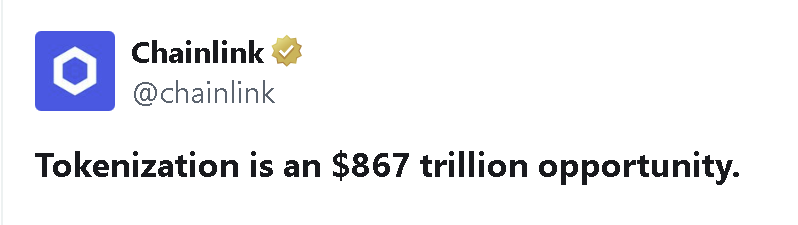
In 2025, sentiment around blockchain and digital assets shifted dramatically, and, decisively for the better. This wasn’t limited to the crypto space: the shift extended across institutional finance, policy making circles, and mainstream media.
Words like tokenization, real-world assets, and stablecoins entered the mainstream vocabulary of regulators, bankers, and institutional leaders, not as buzzwords, but as part of serious, forward-looking discussions about their implementation and adoption.
The narrative flipped. Skepticism and suspicion gave way to recognition. Blockchain stopped being dismissed as a fringe experiment and began to be seen as a maturing technology — one with real-world utility and long-term potential.
Here are just a few quotes from influential voices who helped define that shift:
“U.S. financial markets are poised to move on-chain. Under my leadership, the SEC is prioritizing innovation and embracing new technologies to enable this on-chain future.” — Paul Atkins, U.S. Securities and Exchange Commission
“Tokenisation can modernise the infrastructure that still makes parts of the financial system slow and costly, bringing more people into the world’s most powerful engine of wealth creation: the markets.” Larry FInk
“We look forward to partnering across the industry to tokenize real-world assets safely and securely while advancing the future of finance for generations to come.” — Frank La Salla, President & CEO, DTCC
That change in sentiment carries real weight for DexTrac. Demand is rising. Doors open faster. And perhaps most importantly, we’re no longer seen as “just a blockchain company”, we’re now a trusted technology partner. And that matters.
Chainlink Headed to Washington
 Sergey Nazarov Meeting President Trump at the White House.
We’ve worked with Chainlink since the earliest chapters of their journey, back when “What’s an oracle?” was still a common question. We’ve grown alongside their team and product suite, through the good times — and the even better ones.
So in 2025, watching Chainlink step confidently into the policy arena — helping shape how blockchain is understood at the highest levels, particularly in Washington — was genuinely thrilling.
We’re talking about U.S. government partnerships, direct engagement with regulators and lawmakers, participation in crypto-focused White House events, and substantive dialogue about how blockchain should be governed and adopted.
All of this signals just how far Chainlink has evolved, from an early-stage blockchain project to a trusted voice shaping the future of global finance. The fact that governments are now turning to Sergey and to Chainlink when forming national policy is, quite simply, profound.
For DexTrac, this is the kind of moment that’s impossible not to get excited about. Seeing our closest partner engaged directly with policymakers at the highest levels reinforces our confidence that the industry is heading in the right direction — and that we’re aligned with the people helping define its future.
For a running record of Chainlink’s engagements with U.S. policymakers, regulators, and institutions, this is the resource to bookmark.
Chainlink: A Year of Adoption and Partnerships
 https://pages.chain.link/hubfs/e/Overview_Oracle_Platform_Powering_Institutional_Tokenization.pdf
“Chainlink isn’t just powering price feeds anymore; it’s becoming the backbone of on-chain finance.” — Messari.
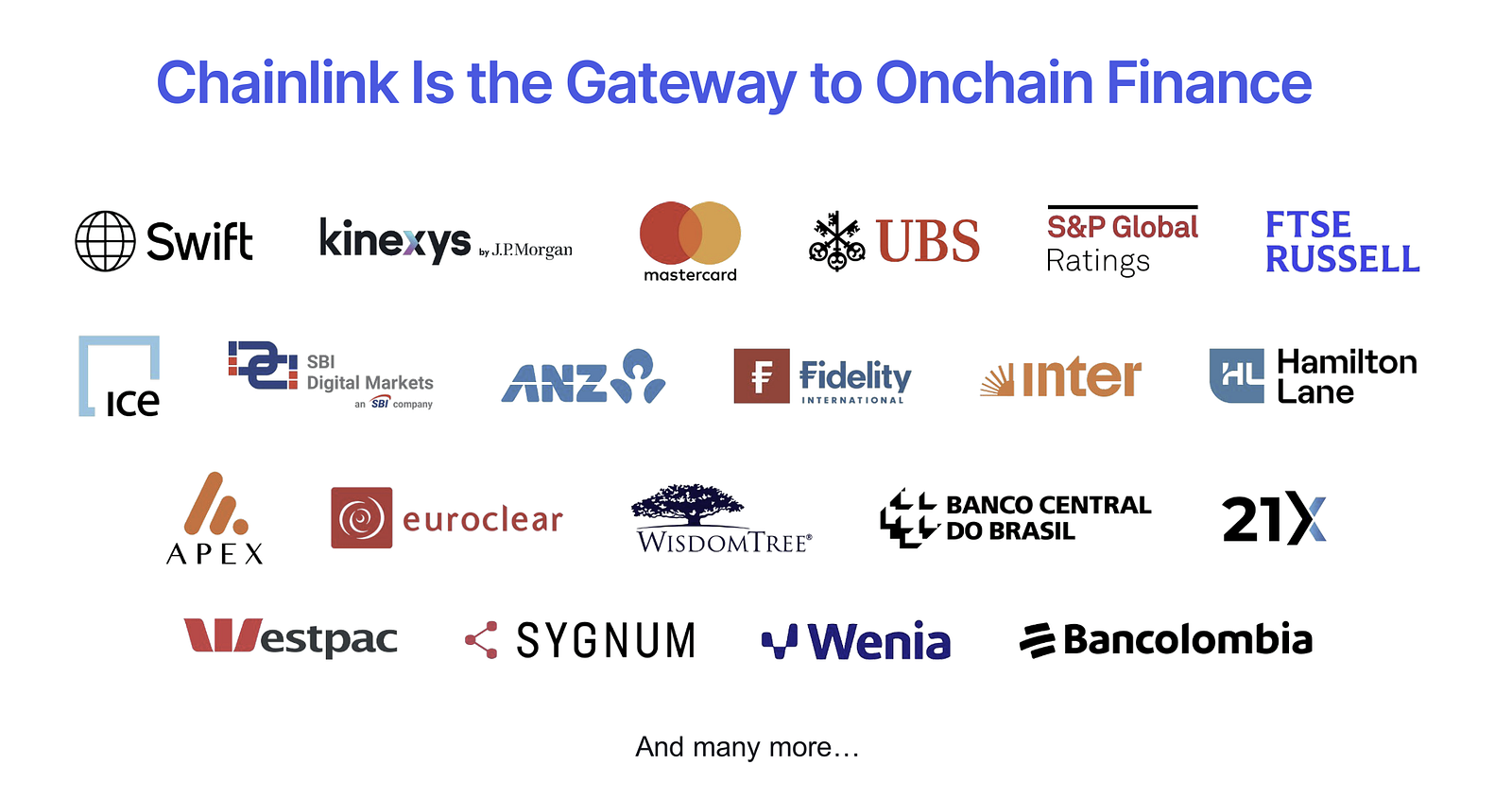
Chainlink’s growing involvement in policy and regulatory conversations was a standout moment from 2025, reflecting its rising standing across the blockchain landscape. But this was not the only signal of the projects continued maturation. Far from it. Just as notable was the growing list of industry heavyweights partnering with Chainlink, rolling out pilots, or deepening long-standing integrations.
Swift, Euroclear, UBS, Kinexys by J.P. Morgan, Mastercard, S&P Dow Jones Indices, Hong Kong Monetary Authority, Monetary Authority of Singapore, State Street, Central Bank of Brazil, Clearstream, FTSE Russell, WisdomTree, Deutsche Börse Group, BNY Mellon, Intercontinental Exchange (ICE), Citi, Bermuda Monetary Authority, BNP Paribas, Edward Jones, Franklin Templeton, Wellington Management, Invesco, Fidelity International, U.S. Bank, Lloyds Banking Group, ANZ Bank, Broadridge, Tradeweb, MFS Investment Management, SBI Group, American Century Investments, Vontobel, Bancolombia, American Trust Custody, Banco Inter, Sygnum Bank, SIX Digital Exchange, ADDX, 21X, APEX Group, BX Digital, Hamilton Lane, Standard Chartered, Sumitomo, SAB, Westpac, Emirates NBD: Source
This level of adoption, from institutions of this calibre, in our view remains without precedent in the blockchain space. Given how closely we work with Chainlink, seeing this list of partners makes one thing clear: 2026 could be full of opportunity.
2025: The Year Enterprises Quietly Chose Chainlink
Finally Some DexTrac Numbers
We’ve already explored the bigger picture, from positive regulatory shifts to the growing adoption and influence of our closest partner, Chainlink. Both trends carry clear positive implications for DexTrac. But the story doesn’t end at the macro level. Look closer, and our own numbers tell a strong story of growth across many of the services we support.
Taken together, these signals reinforce what we see every day: blockchain isn’t emerging — it’s operational, in demand, and scaling. With that context, let’s turn to some standout DexTrac metrics from 2025.
Data Feeds
“With blockchain adoption accelerating across financial services, access to high-integrity data is essential to facilitating institutional adoption at scale.” Source
Chainlink Data Feeds hold a special place in DexTrac’s history. They were the very first Chainlink service we supported — starting back in 2020 with the ETH/USD feed on Ethereum. (And yes, we still proudly support it today.)
Since then, Chainlink has launched a host of new services — some of which, like CCIP, have understandably captured the spotlight. But while attention shifts and new narratives emerge, the foundational importance of data feeds hasn’t wavered. Not for Chainlink. And definitely not for us.
And if you’re looking for proof, let’s talk numbers.
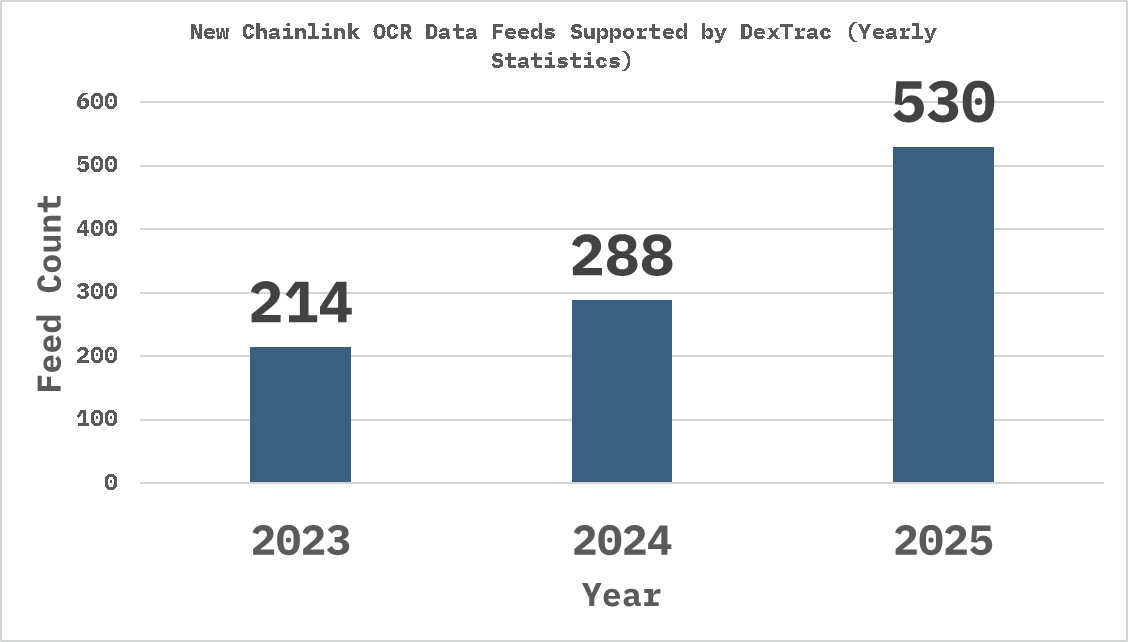
In 2025, DexTrac began supplying decentralized data to 530 new OCR feeds — up from 288 in 2024 and 214 in 2023. That’s an 84% increase year-on-year, and a 147% rise over two years. Let those numbers sink in.
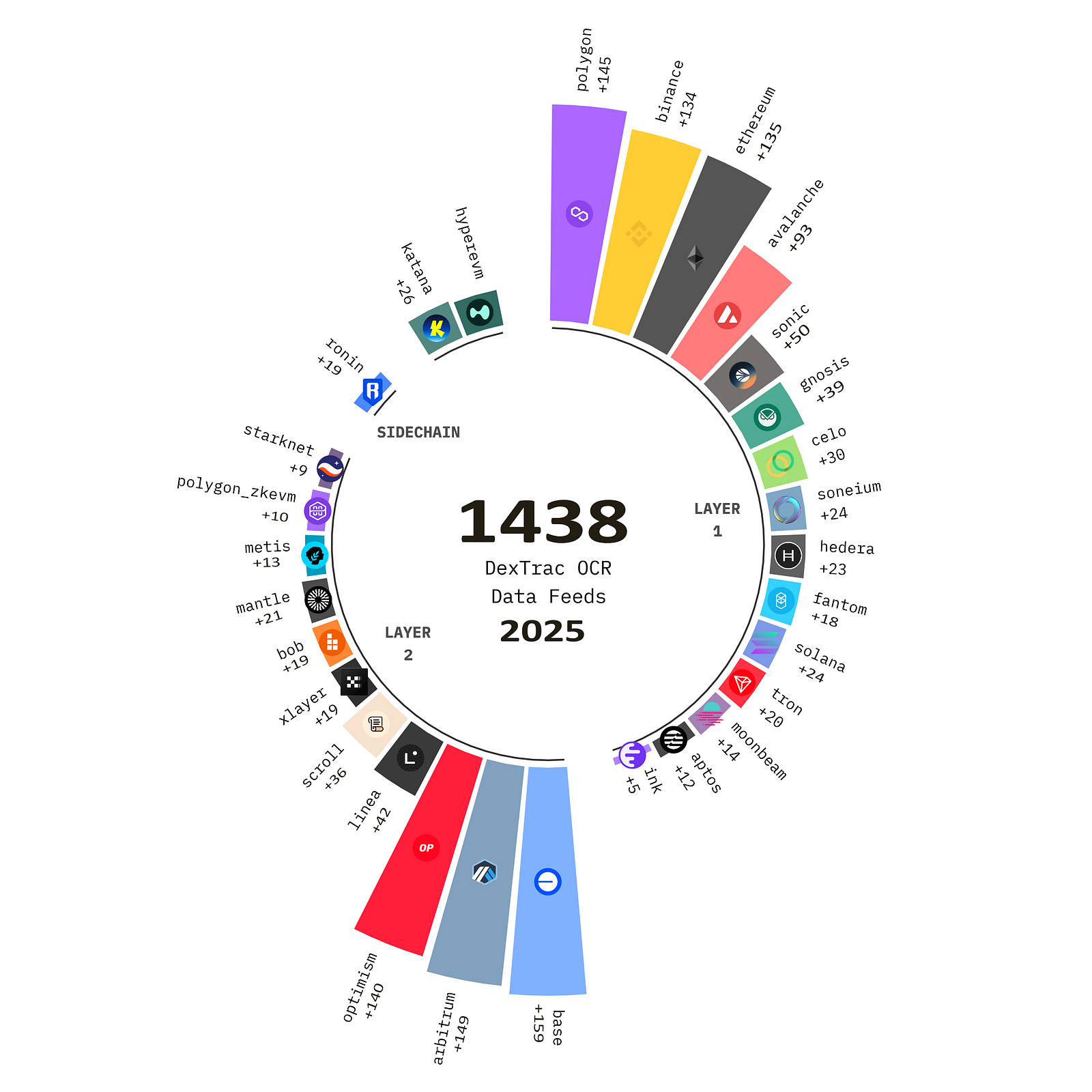
In December 2025, we supported a total of 1,438 OCR feeds across 29 networks — each requiring reliable data, secure peer coordination, compute, and round-the-clock monitoring. That’s 1,438 living, breathing feeds, running 24/7 across multiple blockchain ecosystems. Again, let that sink in.
2025 also saw a major expansion in network coverage. Over the course of the year, we began supporting data feeds on 10 new blockchains, including Aptos, Bob, HyperEVM, Ink, Katana, Mantle, Ronin, Soneium, Sonic, and Tron.
But perhaps most significantly, 2025 saw us bring U.S. Department of Commerce macroeconomic data onchain — a milestone we’ll return to shortly.
Put simply: 2025 was a stellar year for Data Feeds, and all signs suggest that momentum will only build further in 2026.
Data Feed Highlights Worth Noting
Beyond the headline figures, several data feed developments from 2025 are worth highlighting.
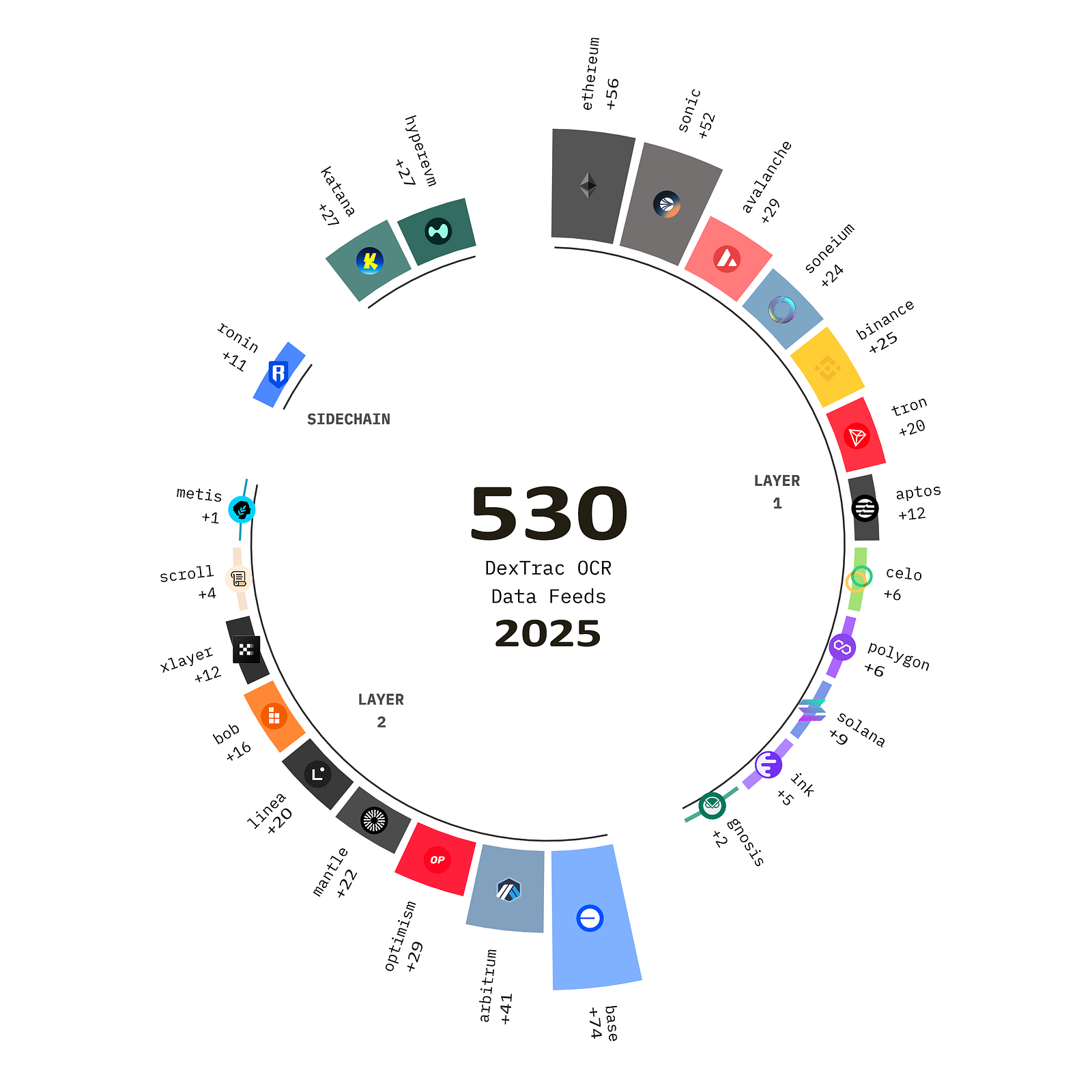
- Base, Coinbase’s Layer 2 network, was once again the chain where we supported the highest number of new feeds — 74 in total — marking the second consecutive year it has topped this list (up from 61 in 2024). In fact, Base is now DexTrac’s largest network by feed count, at 159, reflecting its growing prominence within the broader blockchain ecosystem.
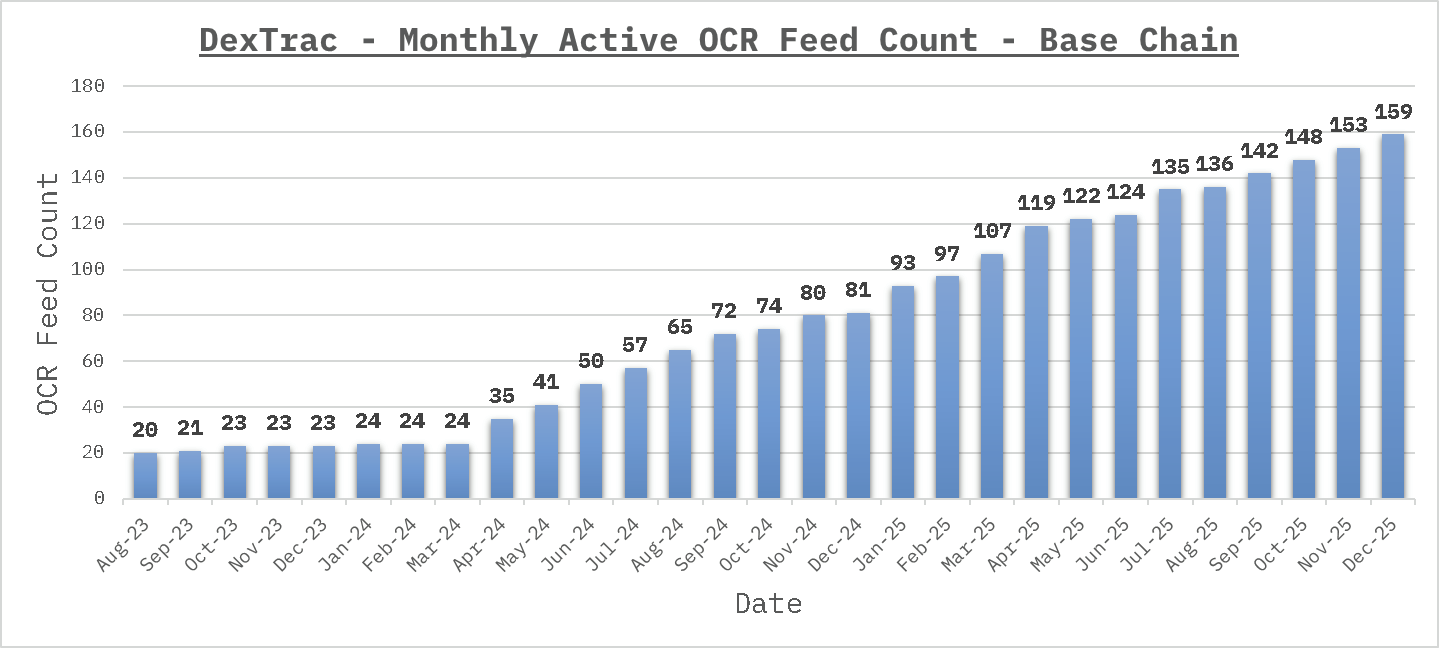
- Meanwhile, Ethereum recorded the second-highest number of new feeds supported in 2025, with 56 added throughout the year. It serves as a reminder that the OG smart contract platform remains a key pillar of the on-chain economy.
- Support for Proof of Reserve and Net Asset Value feeds continued to expand across multiple networks in 2025, including GLDY Reserves, TBILL NAV, USYC NAV, BUIDL NAV, JTRSY NAV, and bgBTC Proof of Reserve. It’s encouraging to witness this trend firsthand, as it points to increasing institutional recognition of the value of on-chain transparency.
- In 2025, DexTrac began supporting Dual Aggregator SVR feeds for Aave on Ethereum — part of a wider move toward infrastructure that improves liquidation efficiency and protocol resilience. We expect this support to extend to additional networks in coming months. For additional details on SVR feeds, see the Chainlink documentation HERE.
U.S. Government Data Feeds
 https://blog.chain.link/united-states-department-of-commerce-macroeconomic-data/
One of the true highlights of 2025 came in August, when Chainlink announced its collaboration with the U.S. Department of Commerce to bring official macroeconomic data on-chain for the first time. This was a landmark moment, not just for Chainlink, but for the entire decentralized data ecosystem.
Being entrusted to support this historic initiative — connecting a federal institution with decentralized networks — was a significant milestone for DexTrac and a moment of genuine pride for the team. It underscored our role as a dependable infrastructure partner, while also highlighting how perceptions of blockchain technology have evolved. What would have sounded implausible just a few years ago became reality in 2025 — and DexTrac was there from the beginning.
At launch, we supported six core datasets across multiple networks — including Arbitrum, Avalanche, Ethereum, and Sonic.
CCIP
If 2025 taught us anything, it’s that there won’t be “one network to rule them all,” but that the future of blockchain will be multi-chain. In fact, institutions from SWIFT to J.P. Morgan, DTCC to ANZ, have all publicly outlined plans to develop their own blockchain networks.
FYI, SWIFT signaled their intent to use Chainlink services.
Once you understand the multi-chain future, the implications are clear: for any blockchain to be useful, it must be able to “talk” to other chains — to move value and exchange messages. DexTrac’s expanding support for CCIP throughout 2025 reflects this reality, underscoring the increasing need for reliable cross-chain connectivity.
By the end of 2025, DexTrac was supporting CCIP on more than 70 blockchains — up from 21 in 2024 (a 233% increase), and just nine the year before (a 678% increase from 2023).
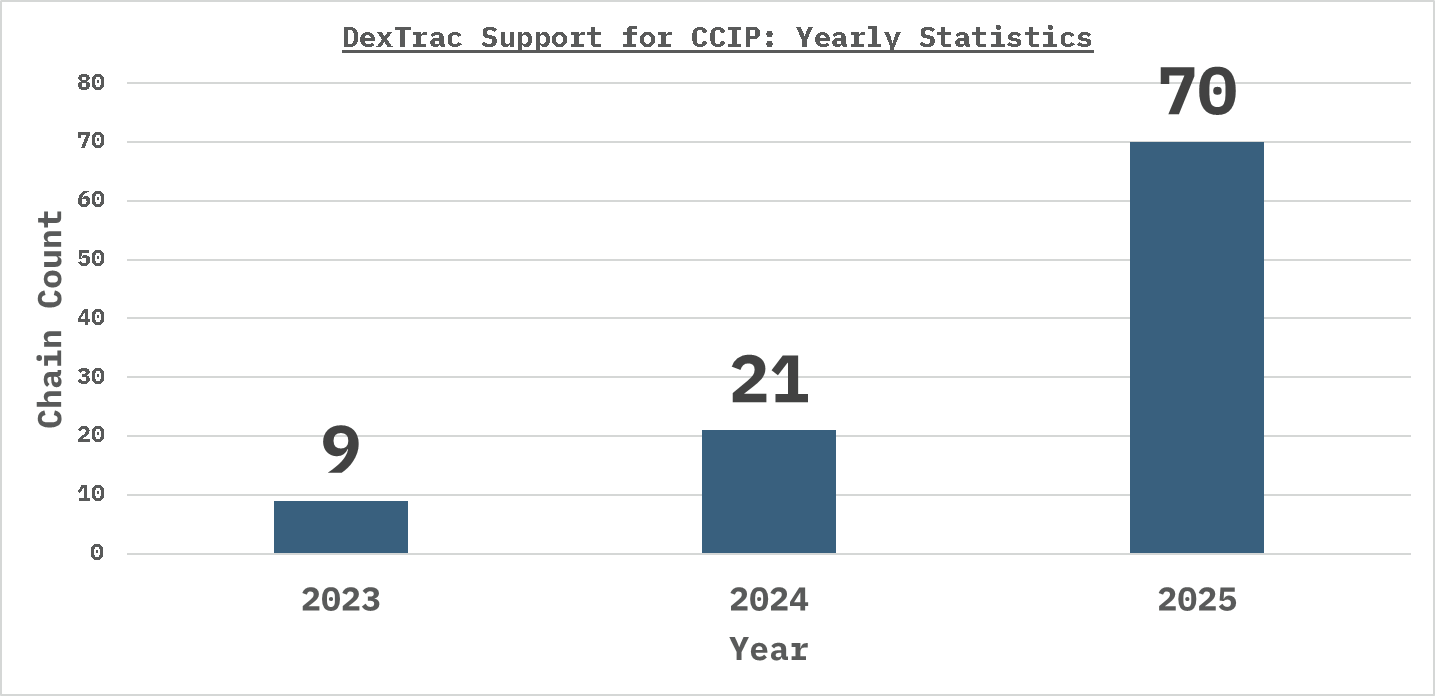
That is extraordinary growth in such a short time span and a clear signal of how vital seamless cross-chain communication has become.
DexTrac’s expanded CCIP coverage in 2025 included several notable networks: Aptos, BOB, INK, Katana, Ronin, Sonic, Soneium, Solana, and Tron.
But it’s not just the number of supported chains that stands out. The dollar value flowing through CCIP also reflects meaningful real-world usage.
While the data (sourced via @CCIPTracker on X) doesn’t capture all participating networks, it still paints a compelling picture: for four straight months in 2025, more than $1 billion in monthly transfer volume was facilitated through CCIP. October alone saw $1.9 billion in value moved.
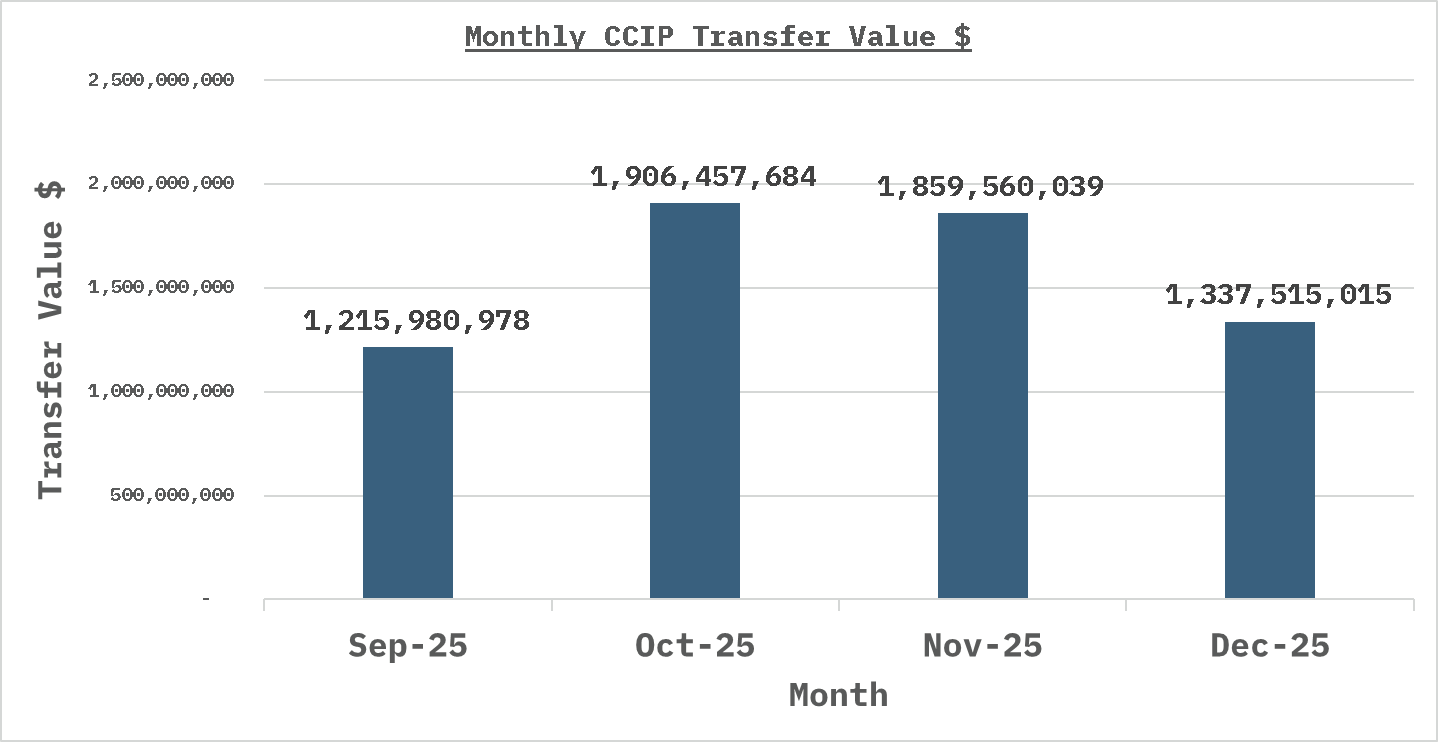
It is important to note that these figures are cumulative across all node operators, not exclusive to DexTrac. But they do highlight something important: we are now actively supporting infrastructure through which billions of dollars flow every month. The trust placed in DexTrac to help run that infrastructure is something we take incredibly seriously.
As players like SWIFT move from pilots to production, we could see those transfer volumes grow dramatically. Watching CCIP adoption accelerate in the coming months is going to be fascinating, and yes, if it wasn’t obvious: we’re not just excited about CCIP, we’re proud to be actively participating in its success and growth.
Data Streams
 Blockchains Utilizing Data Streams
DexTrac has supported Chainlink’s low-latency data service, Data Streams, since its launch in 2023. Initially live on a single network — Arbitrum — the service expanded to six chains in 2024. In 2025, DexTrac supported Data Streams across 41 networks, reflecting a 583% year-on-year increase.
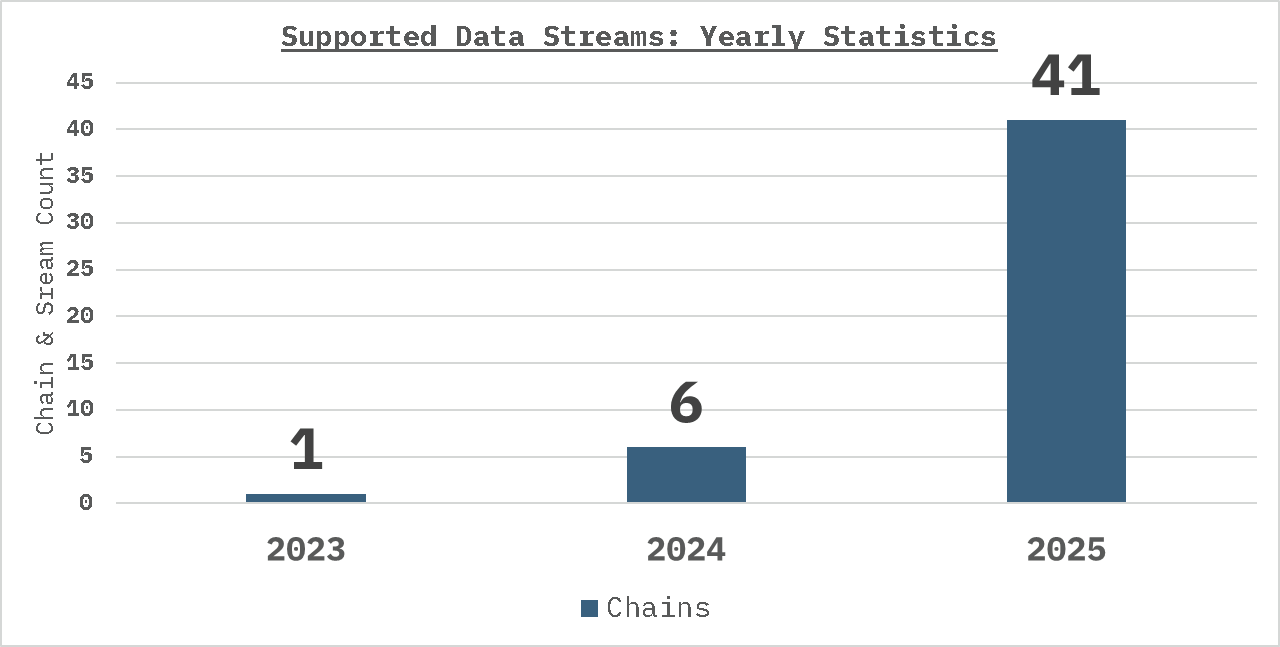
The number of assets supported by Data Streams grew to more than 340 in 2025. At the same time, a growing list of protocols — including Vertex, Kamino, xStocks, and Jupiter — adopted the service. Data Streams, however, is not the only low-latency Chainlink offering DexTrac supports.
Enter DataLink
In 2025, Chainlink launched DataLink, an institutional-grade service that enables leading data providers to publish specialized, high-quality market data directly on-chain.
DexTrac was selected as one of the node operators supporting the initial rollout and now contributes to the delivery of data from some of the most trusted names in global finance, including Deutsche Börse, S&P Global, Tradeweb, and FTSE Russell.
Looking ahead, we’re keen to see how DataLink evolves and which additional data providers begin publishing on-chain in 2026. Exciting!
Some Final Thoughts on Chainlink
 https://blog.chain.link/smartcon-2025-recap/
No DexTrac 2025 review would be complete without mentioning SmartCon. Held in New York this past November, SmartCon 2025 delivered a series of ecosystem announcements that signal how Chainlink is set to evolve in the years ahead.
Key announcements were made around CCC (Confidential Compute), ACE (Compliance), DTA (Transfer Agents), and CRE (Orchestration).
DexTrac is already actively supporting the testing of CRE. Beyond that, the range of new services announced at SmartCon naturally raises questions about where infrastructure providers like DexTrac will be called upon to contribute next.
Taken together, these developments show that Chainlink is evolving beyond a suite of individual services into a unified platform — one that institutions can build with and rely upon as they step into the Web3 space. It’s cross-chain, cross-system, privacy-enhanced, and connected to all the world’s data, with built-in compliance, secure compute, and identity verification. In short, Chainlink is fast becoming the all-in-one platform for blockchain-based systems.
Conclusions — Looking Ahead
DexTrac enters 2026 in a genuinely exciting position. We’re an established Web3 company with years of experience supporting services that increasingly sit at the center of governmental and institutional adoption of decentralized technologies.
We’ve operated through multiple market cycles. The ICO boom. DeFi summer. NFT mania. Memecoins. Some drove genuine progress, others were clearly speculative — but few resulted in lasting structural change. What’s happening now, around tokenization, real-world assets, feels different. It feels more grounded. More serious. In many ways, it feels like the industry is growing up, it’s maturing.
So what will 2026 bring for DexTrac? It could be best summarized into three questions:
- Will the stablecoin and tokenization/RWA trends continue to grow in 2026?
- Will governments and financial institutions deepen their embrace of blockchain technologies?
- Will Chainlink continue to capture a growing share of these expanding markets?
If the answer to those questions is yes — and we believe it is to all three — then DexTrac is positioned for a very strong year.
As Grayscale recently put it:
“Grayscale believes that Chainlink’s suite of software technologies will be central for many applications of blockchain technology, including tokenization and decentralized finance.”: SourceWith our long-standing relationship with Chainlink, and a market that finally feels like it’s hitting its stride, the year ahead looks particularly promising. After all, we support a company whose technology has the potential to connect all blockchains, all networks, and all data sources securely — the same tech already trusted by the U.S. government and global institutions. So what will 2026 bring for DexTrac? If the past year is any indication, it might just be the most significant chapter in our story yet — that is, until 2027.
DexTrac partners with teams to help build, scale, and secure decentralized technologies, systems, and economies. Our services span cross-chain and off-chain data infrastructure, project resiliency design, and oracle operations — as well as validation, white-label solutions, and strategic consulting.
DexTrac’s team combines years of blue-chip experience with deep Web3 knowledge — from shaping major blockchain initiatives to advising global technology firms on digital asset strategy. This expertise in the blockchain space is complemented by enterprise backgrounds with IBM, Microsoft, Trend Micro, Toyota, Chainlink and Kraken, a mix that uniquely equips us to bridge blockchain innovation with institutional needs.
Also published on Medium.